
Methods Used
Comparative Analysis
User Interviews
Stakeholder Interviews
Touchpoint Strategy Map
User Journey Map
Annotated Wireframes
Design Strategy
Tech Used
Axure RP 8
Sketch
Adobe Illustrator
Shir Tikvah Synagogue: A Design Strategy for Moving Into The Future
This case study’s focus was to create a multi-touchpoint Design Strategy for a local Jewish Synagogue: Shir Tikvah.
The synagogue is in the process of some major organizational restructuring.
Identified Goals
Synagogue Vision
Shir Tikvah is a kehila kedosha (holy community) joyfully revealing the intersections of talmud torah (lifelong Torah study), t’filah (prayer), tzedakah (justice), & hachnasat orchim (radical hospitality). We creatively wrestle with tradition and innovation as we invigorate Jewish spiritual life and transform the world.

Design Strategy Statement
Touchpoints for Shir Tikvah will help current congregants and prospective congregants to feel a sense of Kehila Kedosha (holy community). This will be done by connecting members to creative innovation and tradition and the communication of those aspects.
Challenges
When I first began I tried scheduling interviews with the stakeholders and the users. After not receiving any response from the users, and the stakeholders saying that they were too busy with travels and organization planning to do any interviews, I had to start thinking in other directions. I realized that most of the information that I needed could be gathered by talking to people who were similar to the users of Shir Tikvah. I also was able to schedule interviews from some other Rabbis and get their experience and information for their own synagogues.
One of the major themes that kept coming up throughout the interviews was an idea of “community” and “family”. This translates directly to the vision statement of the synagogue where it talks about “Kehila Kedosha,” (holy community).
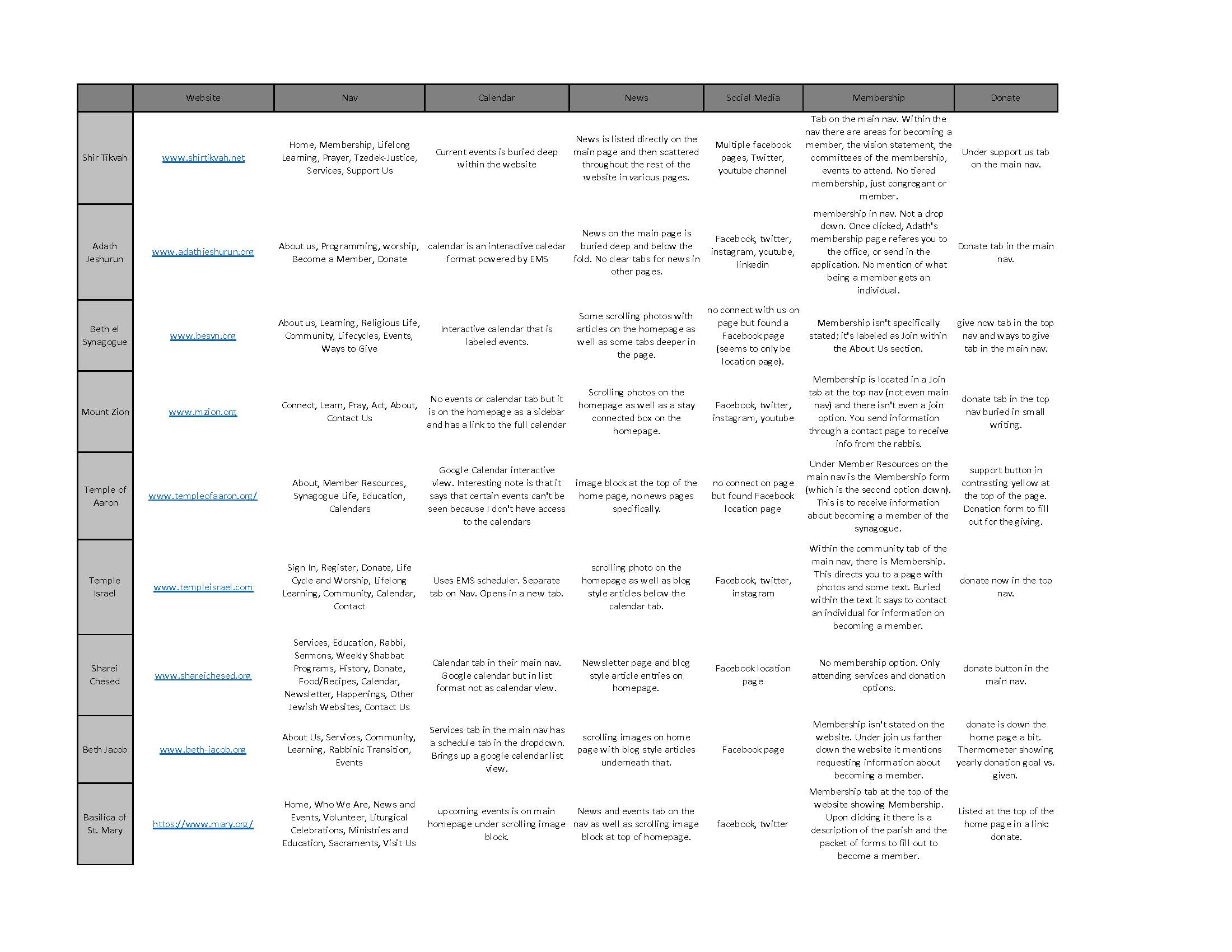
I then conducted a Comparative Analysis of some of the surrounding synagogues as well as non-Jewish religious communities. This analysis showed me the areas of consistency within the Jewish community, as well as areas for imrprovement.
Strategy Development
I then developed the design strategy statement. Revolving around this idea of Kehila Kedosha, it strives to connect the users to this sense of “holy community” by directing the various touchpoints. After developing the strategy statement I began laying out the touchpoints and connecting them together. In the image above, the purple circles are the areas that are clustered – touchpoints that have the most connections. These are the areas I focused on for my recommendations. I then created a digitized Touchpoint Strategy Map to help me structure my recommendations.

Recommendations
With the 6 sections highlighted, I chose to focus mainly on one area of touchpoints: the website. Having the most exposure and strongest presence in the system, I felt that this would be the best place to focus.
Website: I feel that this could be improved by starting with 4 different areas, illustrated using an Annotated Wireframe.
- This area is the Navigation Bar. I feel that by slimming down the options and streamlining the areas it will be easier to navigate. This will ensure that users find the information they are looking for quicker than before.
- This is the News Section of the website. In the original website this area was haphazard and contained multiple different color blocks and fonts. I believe it should be more consistent and the hierarchy improved by only changing the size of the font, not changing the font itself.
- This is the calendar section. I left it mostly the same since it is pretty clear. But i feel that to include the calendar link at the top so that the user can be brought to the calendar mode to see all of the events per month.
- This is the donation area. In the original website it was embedded lower down within the page. I have pulled it up to the top of the page and included a button to watch the streaming temple services.

Streaming Services: By incorporating a streaming service of all of their services, Shir Tikvah can increase it viewer base for when users can’t make it to services but can still remotely access the services.
Social Media: By improving their social media presence and keeping current with their posts, Shir Tikvah can increase their exposure to new prospective members and begin reaching out to a younger generation that is more tech savvy.
Co-Location: The co-location is an interesting concept because it will combine two congregations of different religions. By co-locating with First Universalist Church in Uptown, Shir Tikvah will work on its community presence and community involvement. This will draw more people to the congregation out of curiosity for the co-location model.
Temple Services: By allowing for more socializing time before and after services on-site, the synagogue can improve it’s community feeling especially after a service that encourages group interaction.
Sponsorship: By increasing the number of member-exclusive events and increasing sponsorship opportunities, Shir Tikvah can improve on their member experience.
Conclusion
In conclusion to this project, I presented these findings in an oral presentation.
I found that by focusing on the larger concept of Kehila Kedosha, holy community, in all of its touchpoints, Shir Tikvah can improve its over-all experience for the congregants and continue to move forward into the future of the synagogue.