
Methods Used
Deep Dive
Project Kick-Off Interview
Touchpoint Strategy Map
Tech Used
Sketch
Axure
Adobe Illustrator

Gaard One: Mission Based Design Strategy
This case study’s focus was designing a design strategy.
Taking the clients presented opportunity and creating a design strategy to pivot the company towards their mission-oriented goals.
The Project
Our Team was approached to create a design strategy for Gaard One because they are pivoting their organization to be more mission first.
Gaard One is an outdoor gear company that is a 1:1 B-corp. For every 1 dollar spent, Gaard One conserves 1 square foot of land.
Client Goals (as provided by Gaard One:
To identify key questions around the Gaard One mission of conservation and client base.
To provide hypothesized answers to those questions in a multi-touchpoint strategy.
Formulating the Design Strategy:
We began by doing a deep dive into the company and competitors list provided by Gaard One. Our team began formulating a hypothesis about the gaps in where Gaard One could expand their presence.
After the Deep Dive we had a project kick-off meeting with the primary stakeholders of the company where they described the company’s mission of conservancy and 1:1 nature of that mission. They also identified key areas of Gaard One that they were looking to emphasize and focus on.
We then decided on a targeted user group (Young Urbanite Outdoor Adventurists). We began formulating our design strategy around engaging the users with the outdoors in general as well as the conservation aspect of the company goals.

Design Strategy as an Abstract Described in Concrete Prototypes
Design strategy Statement:
All user experience touchpoints for Gaard One will help young urbanite outdoor enthusiasts to feel confident and personally responsible for saving the world so that they are able to seek adventure in the outdoors. We will do this by developing personal connections to the land and emphasizing the handiness and resourcefulness of the product line.
The design strategy above was created with the goal of increasing users engagement and involvement with Gaard One’s products as well as increasing exposure to the land conserved and outdoor engagement in general.
We began by thinking of all of the different touchpoints where this company could interact with the targeted user. We then identified the key touchpoints that would have the largest impact on the mission first ideal.
Key Touchpoints
The four key touchpoints we identified to improve the 1:1 mission first:
-
Social Media – Facebook posts, Instagram posts, Reviews, Youtube videos.
-
Website – Advocacy page, impacts page, events page
-
Trade Show – Booth impact, outward facing elements of the booth
-
App – Profile description and Augmented Reality hunting game
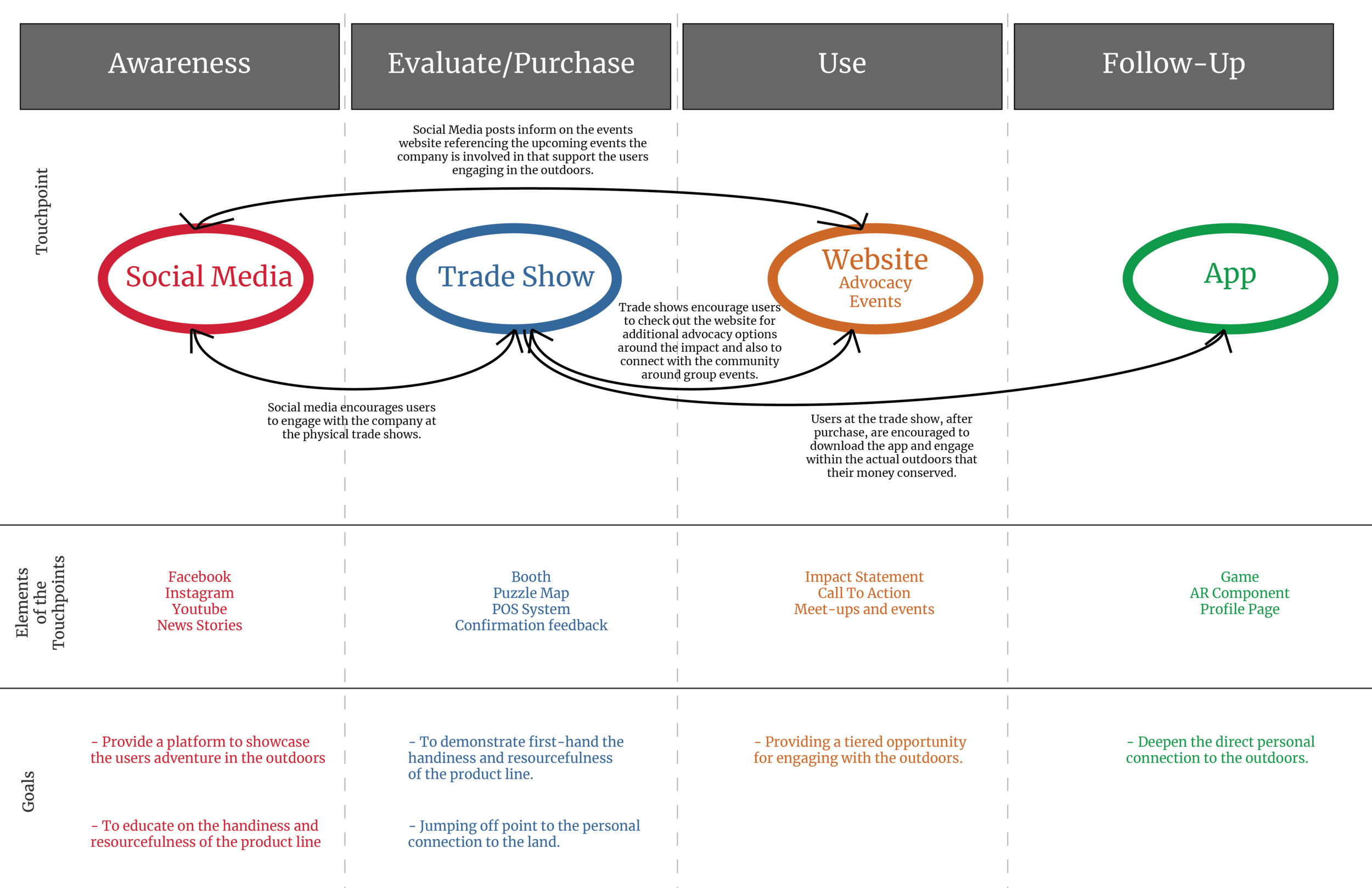
Touchpoint expansions
By implementing new social media posting that revolves around the shows Gaard One attends and not just products they will improve their brand presence surrounding the 1:1 mission. This will drive traffic to the Trade Shows and allow Gaard One to directly interact with the users and promote their mission first goals.
We decided that to increase involvement and ownership of the 1:1 conservation goal, a good implementation of the mission would be to have a puzzle wall at the trade shows to visually represent the land that individual users help to conserve. Also implementing a charging station at the booth would help drive users to the booth out of necessity of use.
We also suggested creating an impact area of the website to showcase the work that Gaard One does to conserve the outdoors. Also creating an events page to increase engagement of the community.
I designed an app that allows users to create a community profile page, show them the land they help to conserve, and create an interactive Augmented Reality hunting game that would allow users, wherever they are, to “hunt” animals found on the land. Also utilizing the game calls that Gaard One is developing to “call” certain animals to their location.
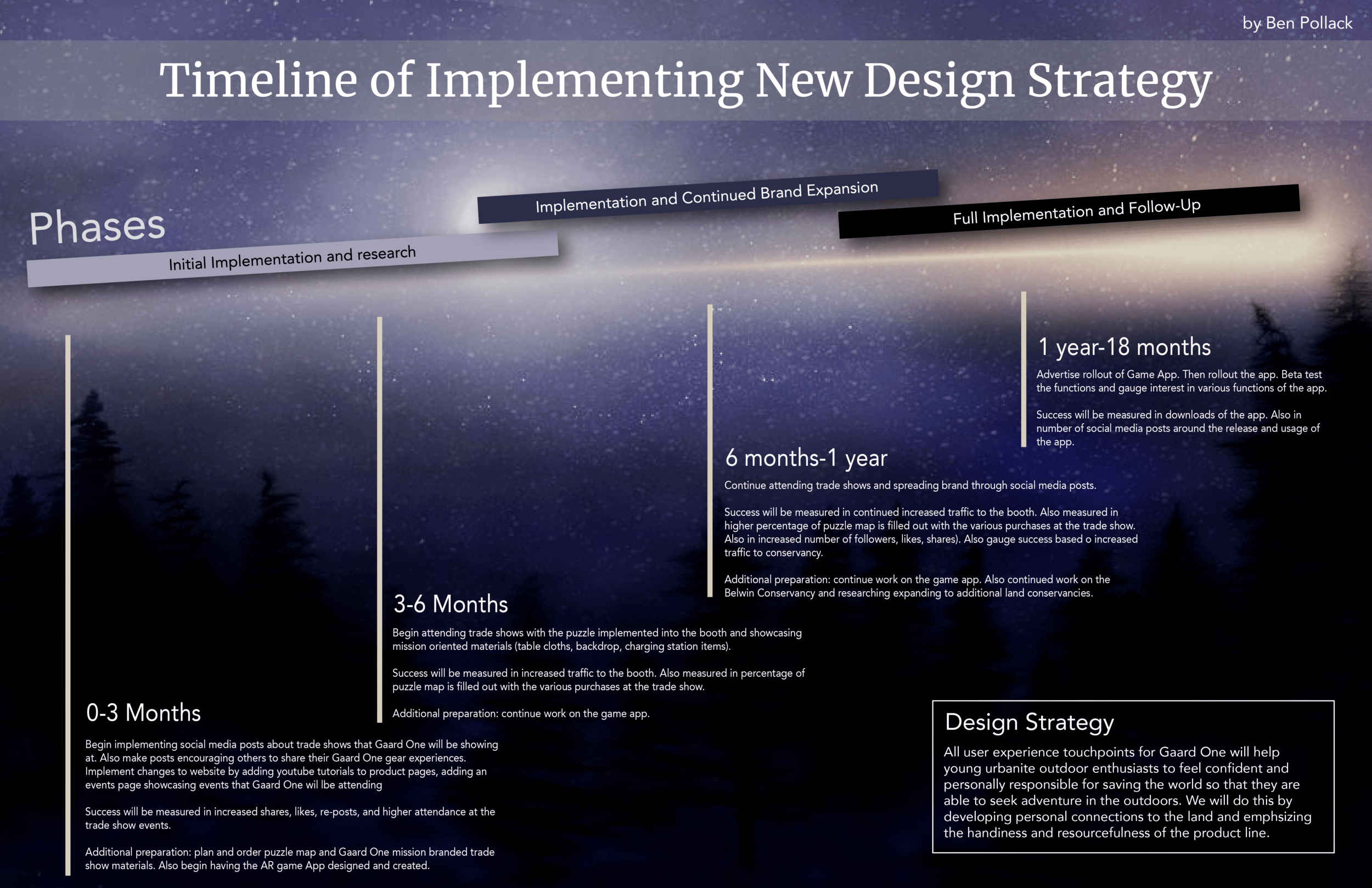
Project Implementation Timeline
I developed a timeline to introduce and implement these suggestions into the user base and give a concrete plan of action in doing that.
Over the course of a year and a half these pieces would be implemented and success would be gauged based on the increased (or decreased) interaction with the users based on certain characteristics of analysis (KPI’s and analytics databases compiled off of the various touchpoints).
Conclusion
Working on this project I learned a lot about Design Strategy as a means of streamlining the process of a company’s business goal pivot. I never considered the fact that design also needs a strategy and that can be a different thing than a business strategy. By thinking of the abstract ideals of a design and then concretely creating prototypes that align to that strategy it moves the company forward in a quick and efficient fashion.
By blending the content of the strategy with the prototype design, we can continue to advance the direct impact to the users. This will always help a business with their goals. By putting the user experience first we can improve the bottom line of the businesses. By creating a story, a narrative that the users vcan engage with we create an experience rather than a product and this will connect to the users on a deeper level.
Doing this project has shown me the way that UX Design is the connective tissue to the business world. It connects the marketing, design, business strategy, business goals, stakeholders and most importantly the users.